
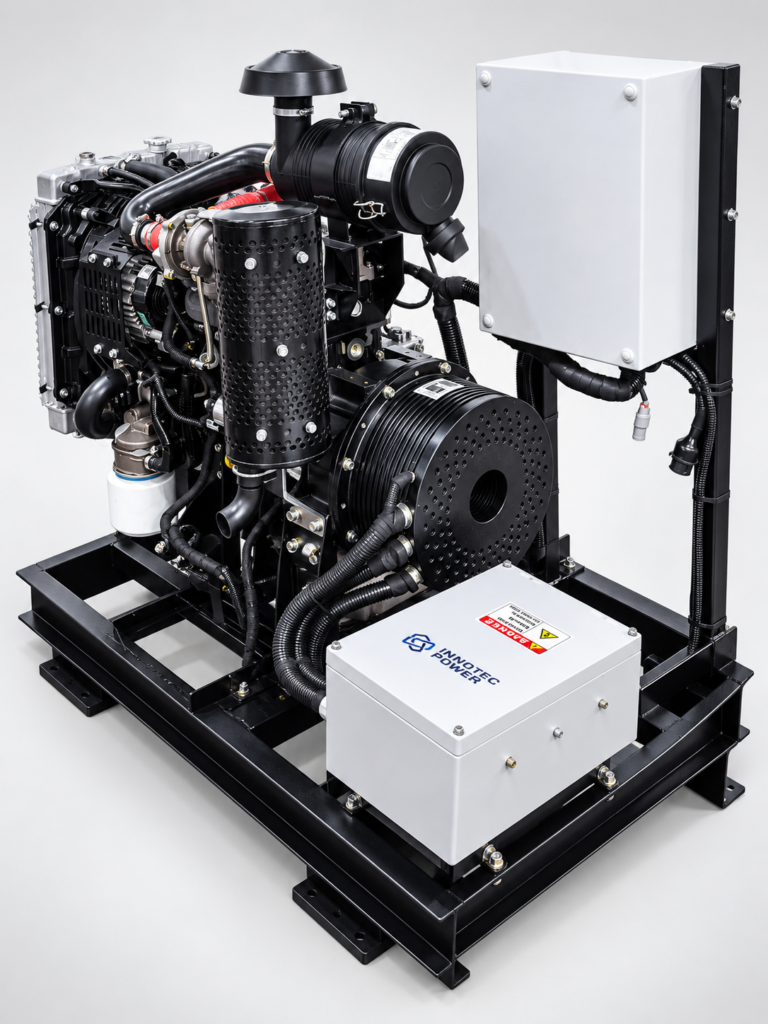
72 V is where a range extender stops being a trickle charger and starts carrying a working vehicle. The same power moves at two-thirds of the 48 V current, so the cable, the connectors and the contactors all come down a size — on a machine that has to carry its own wiring for fifteen years, that is weight you never get back once the architecture is set.
Innotec Power builds the 72 V units as permanent magnet alternators driven by a small combustion engine, feeding the pack directly through a passive rectifier. No inverter stage, no synchronous speed, no mechanical connection to the driveline. The engine is there to make charge and nothing else. The line has been in third-party testing since Innotec first proved DC gensets on its own PMAs in 2014.
The 72 V range extender units
Three frames are built at 72 V, all at 3,000 rpm and all air cooled. The 25 kW frame has no 48 V equivalent — it is the reason a lot of machines move up to this bus.
| Frame | 255-DZ | 345-EZ | 360-EZ |
|---|---|---|---|
| DC output | 5 kW | 15 kW | 25 kW |
| Rated speed | 3,000 rpm | 3,000 rpm | 3,000 rpm |
| Bus voltage | 72 V (also 48 V) | 72 V (also 48 V) | 72 V (also 96 V) |
| Output current | approx. 60–70 A | approx. 180–210 A | approx. 300–345 A |
| Cooling | Air | Air | Air |
| Mounting | Flange | Flange | Foot |
| Shaft | Spline | Spline | Key locking |
| Designed for | High-speed operation | EV and hybrid integration | High-speed, higher-torque duty |
Note the shaft change at 25 kW. The 5 and 15 kW frames use a spline into a driveline; the 360-EZ is foot mounted with a key-locked shaft, which suits a machine bed rather than a vehicle transmission. It is the point where the product stops being a driveline component and becomes a power module.
As finished packages rather than alternators to integrate, the 14 kW and 25 kW sets ship complete at 72 V as DCGO-14-72-KSD1403TC-000 and DCGO-25-72-KDI1903TC-000, charging across a 72–84 VDC window.
Why 72 V rather than 48 V
The arithmetic is the argument. Take the 15 kW unit, which is the volume seller across both buses:
| 15 kW range extender at | Charging window | Current |
|---|---|---|
| 48 V | 48–60 VDC | approx. 250–310 A |
| 72 V | 72–84 VDC | approx. 180–210 A |
A third less current for identical output. That flows straight through to conductor cross-section, connector rating, fuse and contactor size, and the heat all of them have to shed. On an off-road machine or a boat, where the run from the extender to the pack is rarely short, it is usually the deciding factor rather than a refinement.
The trade is component availability. Off-the-shelf 48 V controllers and DC-DC converters are easier to source than 72 V ones, so the auxiliary side of the system wants deciding at design stage rather than at commissioning.
Starter-generator and regenerative duty
The same machine can be programmed to work as a starter motor for its own engine and then switch to generating. On a 72 V machine that removes both the separate starter motor and the dedicated starter battery — parts that exist only to crank an engine which, in a range extender, may run for an hour a day.
It also opens the door to regenerative capability in a series-hybrid driveline, where the same frame recovers energy rather than only producing it. Specify it at the outset: the winding and the controller are chosen differently for dual-direction duty. See starter generators.
What the permanent magnet design buys you
- Overload protection by design. Output current is capped per power and voltage rating, so a deeply discharged pack cannot drag the alternator or the engine past their design point.
- Charging curve, not a fixed voltage. The controller follows the profile the pack chemistry specifies across the 72–84 V window.
- Nothing to service in the alternator. NdFeB magnets, Class H windings, no brushes, no slip rings, no AVR, and a bearing-less or direct-mounted rotor on most builds.
- Power to weight. Substantially smaller than a conventional machine of the same rating — the reason a 25 kW unit is a practical thing to carry.
- Fuel flexible. Petrol, diesel or LPG micro-engines, with engine speed following charge demand rather than holding a synchronous speed.
Where 72 V range extenders go
- Electric and hybrid construction machinery, where the duty cycle is long and the charge window is short
- Agricultural and off-road equipment, including ATVs and utility vehicles
- Material handling and larger warehouse fleets on extended shifts
- Electric boats and marine series-hybrid propulsion, where cable runs are long
- Ground support equipment and airside vehicles
- Autonomous and remote-operated platforms that cannot return to a charger on schedule
Related: DC generators for hybrid vehicles, DC generators for battery charging, and the 72 V motor range for the traction side of the same driveline.
Frequently asked questions
| What is a 72 V range extender? | A combustion engine driving a permanent magnet alternator that charges a 72 V battery pack on the move, across a 72 to 84 VDC window. It never drives the wheels; it lets the pack be sized for normal duty instead of worst-case range. |
|---|---|
| How much power do the 72 V units make? | 5 kW, 15 kW and 25 kW as standard, all at 3,000 rpm. That is roughly 60 to 70 A, 180 to 210 A and 300 to 345 A across the charging window. |
| Why choose 72 V over 48 V? | Current. The same 15 kW flows at about 195 A at 72 V against about 280 A at 48 V, so conductors, connectors and protection all come down a size. 72 V is also the only bus with a 25 kW frame. |
| Can it start its own engine? | Yes, as an option, and it can take a regenerative role in a series hybrid. That removes the separate starter motor and starter battery. It has to be specified up front because the winding and controller differ. |
| How do the units mount? | The 5 and 15 kW frames are flange mounted with a spline shaft for driveline integration. The 25 kW frame is foot mounted with a key-locked shaft, which suits a machine bed. |
| What is the catch at 72 V? | Component sourcing, not the generator. Controllers, converters and contactors are easier to find off the shelf at 48 V, so the auxiliary side of a 72 V system needs deciding at design stage. |